
Reading books about music and your favorite musicians can sometimes have dire consequences when you find out things about the subject of the book. I have read a couple of those. Books written by roadies and ex-wives and hangers-on. However, there are some that can really shed some light and are amazing.
I have always been a fan of David Bowie, and in particular the period known as his Berlin period wherein he crafted the albums “Low” “Heroes” and “Lodger”. This was also the time that he and compatriot Iggy Pop got themselves straightened out (mostly) and worked together for a while.
This book by Thomas Jerome Seabrook seemed right up my alley, about those Berlin era albums and I decided to take a chance.

This book turned out to be fantastic. At 254 pages it is a very detailed look at David Bowie during the years he and Iggy Pop needed to detach themselves from America and try and restart lives in a place where they could live in relatively anonymity.
There were drug problems, wife problems, legal problems and problems with the record company who seemed to think that Bowie’s new direction was career suicide.
Nonetheless, with the help of many key players, including Brian Eno, what was produced inspired myself as a listener and a host of bands who walked through the door that Bowie opened.
In terms of the book itself, it was very well written. It didn’t dip into the salacious or delve too deeply into Bowies life and times outside the making of the albums. It begins during the “Station To Station” period and the chaos that was David’s life at that time. It follows him, and Iggy, and their encampment in Europe and the beginnings of what would be come to be a whole new step towards something new.

As a big fan of the album “Low” it was very interesting to understand the vision that David had for the music and the process that formed it.
Every decision affected the output. Who to work with, who to produce it, when they practiced and in what groupings. The recording studio and what technology was available was also a factor.
The book gives lots of narrative to appeal to the casual Bowie fan, but also detail regarding the album and the individual tracks that is very important to this work. Details about who played what and if there was any backstory to the songs. A perfect combination if you ask me of detail and history.
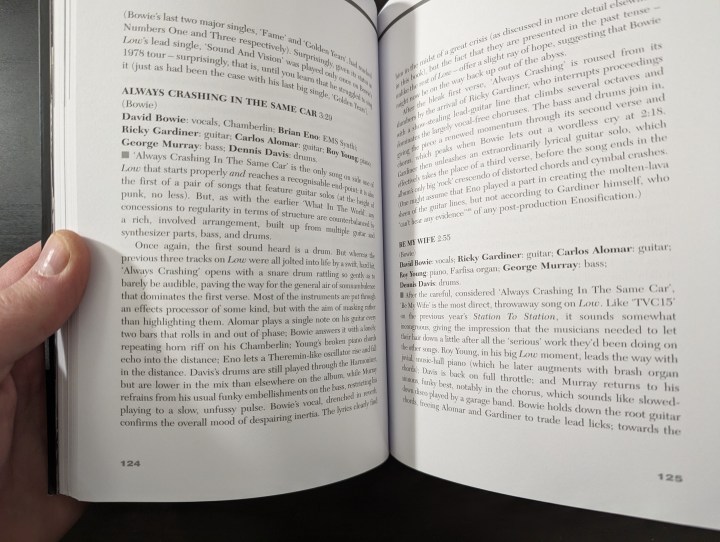
On “Heroes” and “Lodger” Robert Fripp and Adrian Belew were brought in to play guitar and lend atmosphere to the music, only they didn’t play with the band. Bowie brought them in and they were told to “play”. They recorded hours of them playing whatever came to them without having any concept of direction. Then their work was sampled, dissected and sent through Brian Eno’s treatments before ending up on the album. This was certainly something I didn’t know.
I also didn’t really realize the efforts that Bowie took with regards to Iggy Pop, but as the 2 Iggy Pop albums “The Idiot” and “Lust For Life” were created during this period as well they are included in the book. Bowie produced and co-wrote the whole album and even toured with Iggy for “The Idiot” playing keyboards. With “Lust For Life” Iggy took more control, but again was bolstered by Bowie’s work. These albums are also included in the book, including the song by song breakdowns.

Also mentioned in the book is Bowie’s acting work in “The Man Who Fell To Earth” and other films. Some of the music that Bowie had in mind for a soundtrack for the film (that he was not selected to create) became the direction that he ended up going for part of “Low”.
The book is a great read and I highly recommend it if you are into that period of Bowie’s work and are interested in some of the behind the scenes information on the players and the process.

 The Aural Retentive